
You've moved abroad for work, or you're studying in another country, or you travel for months at a time. And then a US app asks for a US phone number, or your American bank texts a code to a number you no longer have with you.
Suddenly the +1 in front of a phone number feels like a locked door.
The good news is that there are several ways to get a US number from anywhere in the world. The less good news is that they aren't all the same, and picking the wrong one can cause real headaches. Let's walk through your options honestly.
Why people need a US number abroad
The reasons are usually practical:
Keeping US accounts working. Banks, brokerages, and government services often send security codes to a US number.
Signing up for US-based apps and services that only accept +1 numbers.
Avoiding roaming costs. Paying international rates just to receive a text is painful.
Business presence. A US number can make a small business easier to reach for American customers.
Privacy. Keeping your personal number out of every sign-up form is smart, wherever you live. (We cover that in our guide to protecting your phone number from spam and leaks.)
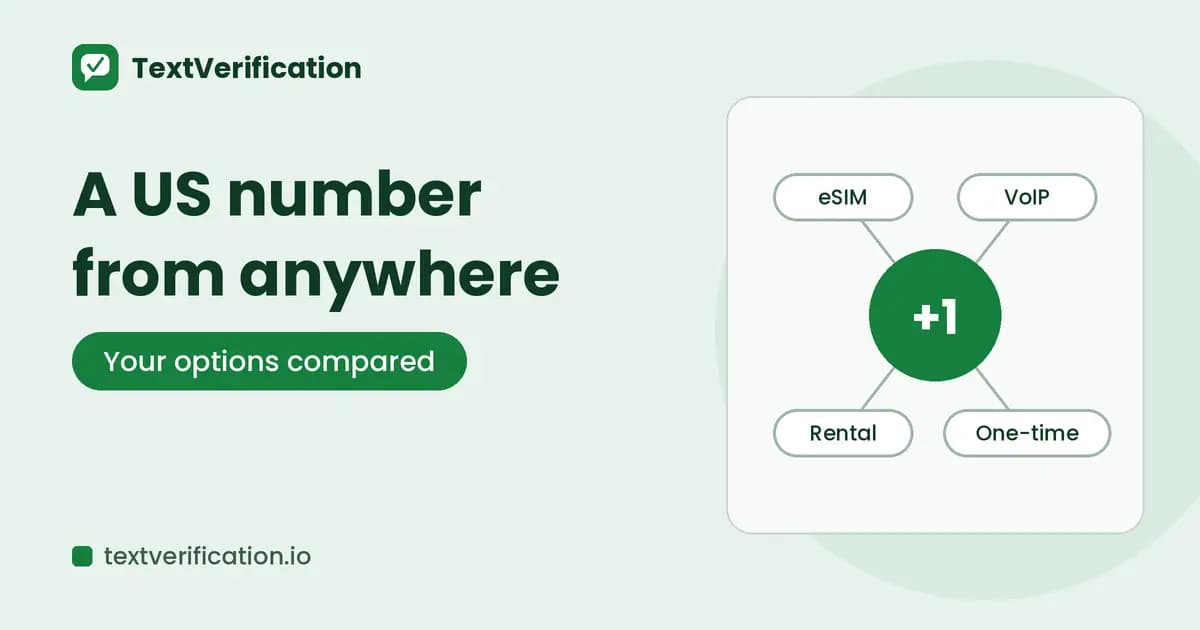
Your five options
1. Keep your existing US SIM active If you already have a US number, the simplest fix is often to keep it alive. Some carriers have very cheap plans that keep a line active, and you can receive texts over Wi-Fi in many cases. It's the most reliable choice for banking, because it's your own permanent number.
2. A US eSIM Some providers sell eSIM plans that give you a US mobile number you can use on a compatible phone, with no physical card. It's a real carrier line, so it behaves like any mobile number. The catch is that you need an eSIM-compatible, unlocked phone, and plans have monthly fees.
3. A VoIP or calling-app number Apps can give you a US number that works over the internet. They're cheap and great for calls. Many of them are classified as VoIP, though, and a lot of banks and apps reject VoIP numbers for verification. Some also expect you to already have a US number to set them up. We explain the difference in our VoIP vs non-VoIP guide.
4. A virtual number service "Virtual number" is a broad label. Some are VoIP, and some are issued by real carriers. Always check which type you're getting, because that decides whether strict apps will accept it.
5. A one-time or rental carrier-issued number This is the category we work in at TextVerification. You get a US, carrier-issued (non-VoIP) number just to receive SMS codes, either for a single verification or rented for days or months. It's not a replacement for a phone plan. It's a tool for receiving texts.
Comparing them side by side
Option | Real carrier line? | Best for | Main downside |
|---|---|---|---|
Keep your US SIM | Yes | Banking, long-term accounts | Monthly cost, needs upkeep |
US eSIM | Yes | Daily use of a US number | Needs a compatible phone, monthly fee |
VoIP / calling app | No | Cheap calls, business line | Often rejected for verification |
Virtual number service | Depends | Varies | Hard to know the line type |
One-time or rental number | Yes (carrier-issued) | Receiving SMS codes, privacy, testing | Receive-only, not a full phone plan |
One-time or rental: which one?
If you go with a number from us or a similar service, this choice matters.
One-time number: Meant for a single verification. You use it, get your code, and you're done. It's valid for a short window, so it's not meant for accounts where you'll need codes again later.
Rental number: You keep the number for days, weeks, or months, so you can receive codes again when you log in or when the app asks you to re-verify.
A simple rule: if you'll ever need that number again for this account, rent it. If you won't, a one-time number is enough.
A caution about banks and official accounts
This is important, so we'll say it plainly. For banking, tax, government, and other official accounts, use a permanent number that is really yours, such as your own SIM or eSIM. These institutions usually expect a number tied to you for the long term, and many have rules about it. If a temporary number expires, you could be locked out of an account that matters.
Temporary and rental numbers are better suited to everyday app sign-ups, privacy, testing, and business profiles, not to the accounts you can't afford to lose.
How to receive a US code while abroad
Here's the simple path with a carrier-issued number:
Create an account and add balance. We accept crypto payments, which is handy if you don't have a US bank card. See pricing.
Choose the service you're verifying with, and pick a one-time or rental number.
Enter the number in the app you're signing up for.
Wait for the code. It appears in your private dashboard, not on a public page. (If you're wondering why that matters, read why free SMS sites are risky.)
Type the code into the app. If no code arrives before the number expires, the amount goes back to your balance automatically.
No service can promise that every app will accept every number, so treat this as a tool that improves your chances, not a guarantee.
Staying on the right side of the rules
A US number doesn't change who you are or where you live. Some services require a US address, a US bank account, or US residency, and a phone number alone won't satisfy that. Always be honest on sign-up forms, follow each service's terms, and respect local laws where you live. Our numbers are for lawful uses like privacy, testing, business profiles, and verifying services while you're abroad.
Quick FAQ
Can I get a US number without a SIM card? Yes. eSIMs, VoIP apps, and virtual or rental numbers all work without a physical SIM.
Will a US number work for apps like WhatsApp or Telegram? It depends on the app and the number type. Carrier-issued numbers are accepted more often than VoIP ones, but nobody can guarantee a result.
Can I make calls with these numbers? Our numbers are built for receiving SMS verification codes, not for phone calls. For calling, an eSIM or calling app is a better fit.
What happens if I rent a number and stop paying? The rental ends, and the number may go to someone else. Don't tie an account you care about to a rental you won't keep paying for. More answers are in our FAQ.
The takeaway
Getting a US number from abroad is easy once you know what you need it for. Use your own SIM or eSIM for the accounts that matter most, and use a carrier-issued one-time or rental number for everyday sign-ups, privacy, and testing.
Want to try it? Create a free account and see which US numbers are available today.