
Not every online account needs the same kind of phone number.
If you're testing a website, you might only need a number for a short time. But if you're registering for a business platform that you expect to use for years, losing access to that number could become a serious problem.
This is where the difference between temporary and permanent phone numbers matters.
Both options can be useful, depending on the service and your purpose. A temporary number may be convenient for a short-term verification task, while a permanent number is often a better choice for accounts that require ongoing access, password recovery, or regular communication.
The right choice isn't simply about finding the cheapest number. You also need to consider privacy, availability, platform restrictions, and what happens when you need to verify your account again.
Let's compare the two options and look at when each one makes sense.
What Is a Temporary Phone Number?
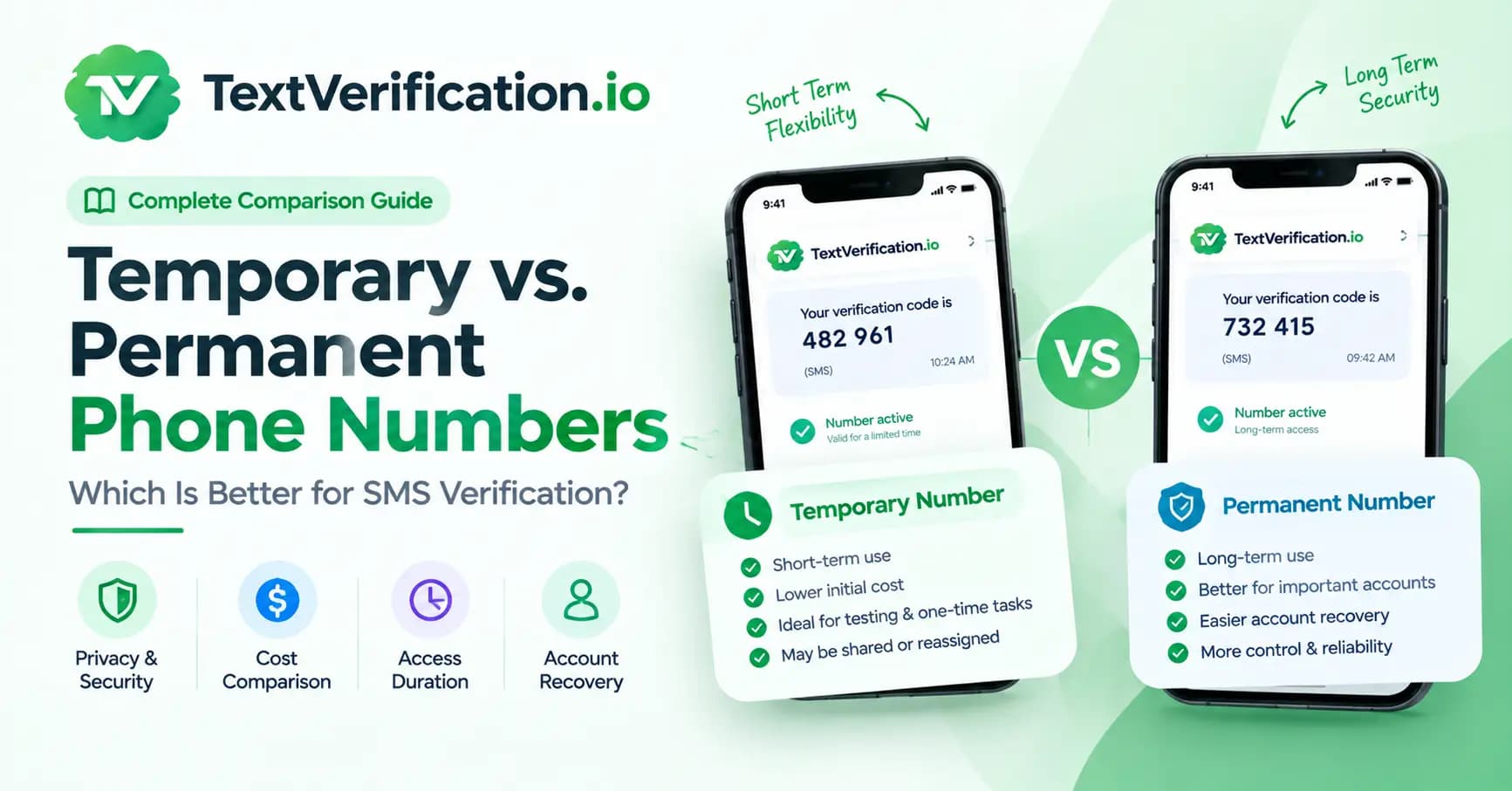
A temporary phone number is a number available for a limited period or a specific purpose. Depending on the provider, access might last for a single verification session, a short period, or a longer rental term.
People and businesses may use temporary numbers for tasks such as:
Testing an application's registration process.
Verifying an account on a supported online service.
Keeping certain communications separate from a personal number.
Testing how an SMS verification workflow behaves.
Completing a short-term project that does not require ongoing access.
The exact features depend on the provider. Some services offer numbers for receiving a single verification message, while others provide access for a defined rental period.
One important point: temporary does not necessarily mean private, exclusive, or anonymous. A number may be shared, reassigned, or subject to provider-specific access rules.
Before using one, understand who can access incoming messages and how long you will be able to use the number.
What Is a Permanent Phone Number?
A permanent phone number is a number you intend to keep and control over the long term.
It may be a conventional mobile number or another type of number provided under a service agreement that supports continued access. The exact meaning of permanent depends on the provider and the terms of service.
A long-term number is often more suitable for:
Personal email accounts.
Business accounts and customer communication.
Financial services that require recurring verification.
Social media accounts you expect to maintain.
Password recovery and security notifications.
Accounts that may request another verification code in the future.
A permanent number does not guarantee that an account will always remain accessible. You still need to keep the number active, follow the provider's terms, and maintain any required billing or subscription.
However, continued control over the number can make future verification and account recovery easier.
Temporary vs. Permanent Phone Numbers: Key Differences
Here's a practical comparison of the two options.
Feature | Temporary Phone Number | Permanent Phone Number |
|---|---|---|
Intended use | Short-term or specific tasks | Ongoing communication and account access |
Access period | Limited or rental-based | Intended for long-term use |
Initial cost | May be lower for short tasks | May involve recurring charges |
Future verification | Depends on continued availability | Usually more practical if the number remains active |
Account recovery | Can be difficult after access expires | Generally more suitable for long-term recovery |
Privacy | Depends on exclusivity and provider practices | Depends on ownership, provider, and security |
Number reuse | May be shared or reassigned under provider rules | May also be reassigned after service ends |
Best suited for | Supported short-term verification and testing | Important accounts and recurring verification |
Neither option is automatically better for every situation. The main question is how long you need the number and whether you may need it again.
When Should You Use a Temporary Phone Number?
Temporary numbers can be useful when the task is limited and you understand the access restrictions.
1. Testing Websites and Applications
Developers often need to test different registration scenarios before releasing an application.
For example, a developer might check whether an OTP form handles valid codes, expired codes, incorrect entries, and resend requests correctly.
A temporary number may be suitable for a supported test workflow, particularly when the number is not tied to a critical personal account.
For software development, dedicated test numbers or a provider's test environment may be preferable because they offer more predictable results.
2. Short-Term Verification Tasks
Some services require phone verification only for a particular action. If the platform permits the number type and no future access is required, a temporary number may be sufficient.
However, don't assume that every website accepts temporary numbers. Platforms may restrict certain number types, countries, providers, or previously used numbers.
Check the platform's rules before purchasing a number.
3. Separating Certain Communications
A separate number can help keep project-related communications apart from personal calls and messages.
This can be useful for short-term projects or testing, provided you understand who controls the number and who may be able to access its messages.
If you need the number for an ongoing business relationship, a long-term number may be more appropriate.
4. Managing Short-Term Costs
A temporary number may cost less when you only need brief access.
But price alone should not determine your choice. If the number fails to work with your intended service or you need to purchase another one, the overall cost may be higher than expected.
Check the number's supported features, expiration period, and refund policy before paying.
When Is a Permanent Phone Number the Better Choice?
For accounts you expect to keep, reliable long-term access is often more important than saving a small amount upfront.
1. Important Email Accounts
Email accounts are frequently used to reset passwords and recover access to other services.
If your account relies on phone verification, losing access to the number may complicate future recovery.
For an important email account, consider using a number you control over the long term and keeping alternative recovery methods up to date.
2. Banking and Financial Services
Financial platforms may have strict rules about supported phone numbers and account ownership.
Use a number that meets the institution's requirements and remains under your control. A temporary number may be unsuitable if you need it for transaction alerts, identity checks, or account recovery.
Always follow the institution's official verification process.
3. Business and Customer Accounts
A business account may be connected to customers, payments, advertising, or internal operations.
Changing the associated number can require extra verification and administrative work. A stable number can make ongoing account management easier.
For business-critical accounts, consider who will control the number if an employee leaves or a service agreement changes.
4. Social Media and Other Long-Term Accounts
Some platforms periodically ask users to verify their phone numbers again, particularly after account changes or suspicious activity.
If you no longer have access to the original number, you may need to complete an alternative recovery process.
A number you can retain is generally more practical for an account you expect to use over several years.
Which Option Is Better for Privacy?
Privacy is one of the most common reasons people consider a separate phone number. But temporary numbers and permanent numbers offer different kinds of control.
A temporary number can help separate a specific activity from your primary number. However, that benefit depends on the service.
If a number is shared or reused, other users may potentially receive messages intended for a previous user, depending on the provider's design and access controls. You should never assume that a temporary number gives you exclusive access.
A permanent number can offer more continuity, but it may still be linked to your identity through the provider, billing records, or other information.
Before choosing either option, consider these questions:
Will I have exclusive access to incoming messages?
How long will the provider retain access to the number?
Can the number be reused after the service ends?
What personal information does the provider collect?
Will I need this number for account recovery later?
For sensitive accounts, use a number you control and review the service's privacy practices. Avoid sending confidential information through services that do not clearly explain how incoming messages are handled.
What About VoIP and Non-VoIP Numbers?
The duration of access is only one part of the decision. Number classification can also affect compatibility.
VoIP numbers are associated with internet-based voice communication services. Non-VoIP is a classification used to distinguish numbers that are not identified as VoIP by the relevant provider or classification system.
Some websites restrict certain VoIP numbers, while others accept them. The same variation applies to virtual and temporary numbers more broadly.
It's important not to confuse these separate characteristics:
Temporary vs. permanent describes the intended access period.
VoIP vs. non-VoIP describes a number's classification.
Virtual vs. physical or conventional mobile service describes how a number is provided or accessed, depending on context.
A number can have one characteristic without necessarily having another.
For example, a number offered for a limited period is not automatically VoIP. Similarly, a non-VoIP classification does not guarantee that a website will accept it.
If compatibility is important, review the platform's published requirements and the number provider's actual specifications.
How Much Does Each Option Cost?
There is no single price that applies to all temporary and permanent phone numbers.
Temporary services may charge per verification attempt, per number, or for a defined rental period. Permanent numbers may involve monthly plans, prepaid balances, or other recurring fees.
Your actual cost depends on the provider, country, number type, service features, and how long you need access.
Before purchasing, compare:
Initial cost: What do you pay to obtain the number?
Ongoing cost: Is there a rental fee or recurring subscription?
Access period: When will access expire, and can you renew it?
Failed verification policy: What happens if the platform rejects the number or the message does not arrive?
Future access: Will you need to pay again if you need another verification code later?
A low initial price may be attractive for a one-time task. For an important account, however, continuity and recovery options may be worth more than the initial savings.
How to Choose the Right Phone Number
If you're unsure which option fits your situation, work through this short checklist.
Choose a Temporary Number If:
You need access for a clearly limited task.
The intended platform permits the number type.
You understand the provider's access and expiration rules.
The account does not depend on future access to that number.
You are not using the number as the sole recovery method for a critical account.
Choose a Permanent Number If:
You expect to use the account for a long time.
You may need phone verification again.
The number is important for password recovery.
You need ongoing customer or business communication.
You want greater continuity and control over future messages.
If the account is important and you are uncertain, a number you can reliably retain is usually the more practical option.
How TextVerification.io Fits Into Your Decision
If you need a phone number for a supported SMS verification task, you can explore the available services at TextVerification.io.
Before choosing a number, consider the purpose of your verification, the required country, the number type accepted by the receiving platform, and how long you need access.
Review the current pricing and terms to understand the available access periods and any relevant restrictions.
If you need a number only for a short-term task, check whether the available service matches that requirement. If you expect to use an account for a long time, make sure the number and access arrangement suit your future verification and recovery needs.
Remember that purchasing a number does not guarantee acceptance by a third-party website. Each platform applies its own verification rules.
The best choice is the one that meets your actual requirements without creating unnecessary problems later.
Frequently Asked Questions
Is a temporary phone number better than a permanent number?
Neither is universally better. Temporary numbers can suit supported short-term tasks, while permanent numbers are generally more practical for important accounts that require recurring verification or account recovery.
Can I use a temporary number for account registration?
That depends on the platform's rules and the number's capabilities. Some websites accept certain temporary numbers, while others restrict them. Check the official requirements before proceeding.
Can I recover an account after a temporary number expires?
Possibly, but it may be more difficult if the account requires another code sent to the original number. Recovery depends on the platform's available procedures and the information you can provide.
Are permanent phone numbers more secure?
Not automatically. Security depends on control of the number, provider practices, account settings, and the authentication methods you use. A long-term number may make recovery easier, but it should still be protected.
Do temporary phone numbers always cost less?
No. A temporary number may have a lower initial cost, but failed attempts, repeated purchases, or rental fees can increase the total. Compare the complete pricing terms before deciding.
Can a non-VoIP number be temporary?
Number duration and VoIP classification are different characteristics. Whether a non-VoIP number is available temporarily depends on the provider and its offerings.
Should I use a temporary number for a banking account?
For a financial account, a number you can reliably retain and that meets the institution's requirements is generally the safer practical choice. Follow the institution's official verification and recovery procedures.
What should I check before renting a phone number?
Confirm the supported country, number type, incoming SMS capability, access period, pricing, refund policy, privacy practices, and whether the number is shared or exclusive.
Final Thoughts
Choosing between a temporary and permanent phone number comes down to one simple question: Will you need access to this number again?
If you're completing a short-term, permitted verification task, a temporary number may be enough. If you're registering for an important account, managing a business service, or planning to keep an account for years, long-term access deserves much more attention.
Consider the platform's rules, the provider's terms, and your future account recovery needs before making a decision.
If you're exploring phone numbers for SMS verification, visit TextVerification.io to review the available services and choose an option that fits your use case.
A little planning now can save you from a much bigger account access problem later.