
Imagine you're preparing to launch a new app. Your team has spent weeks working on the design, testing the features, and fixing bugs. Everything seems ready until you start testing account registration.
Some verification codes arrive immediately. Others take longer than expected. A few numbers cannot receive the code at all.
If you've ever managed a website, tested an application, or worked with multiple online accounts, you probably know how frustrating this can become.
Handling one verification request is usually straightforward. Managing several accounts, testing different user journeys, or working with multiple phone numbers can be more complicated.
That's where a structured SMS verification workflow becomes useful.
In this guide, we'll explain what bulk SMS verification means, how it differs from ordinary bulk messaging, when businesses might need multiple phone numbers, and how to choose a suitable verification solution.
What Is Bulk SMS Verification?
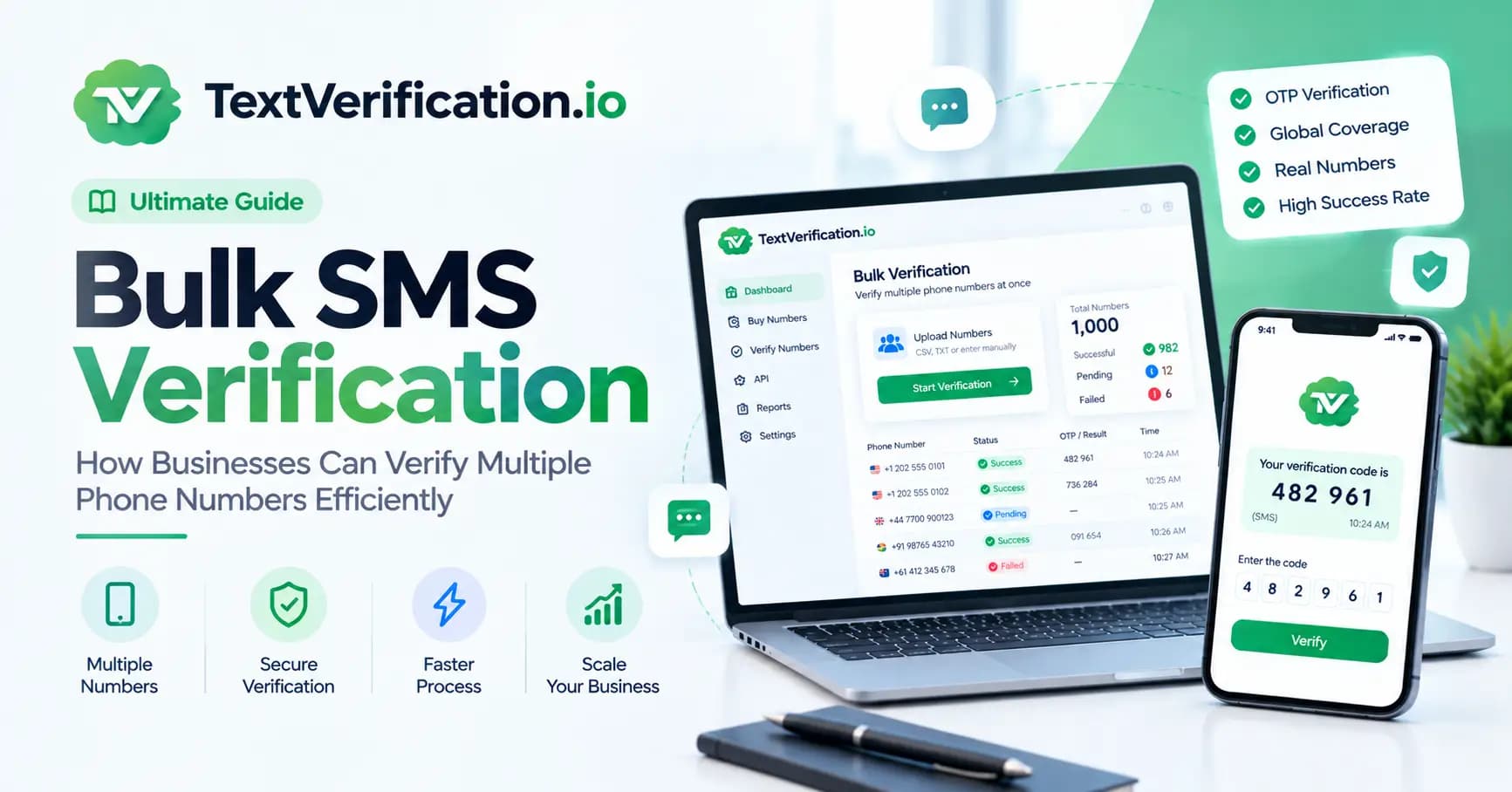
Bulk SMS verification generally refers to handling phone verification across multiple numbers or verification requests rather than processing each one as an isolated task.
The exact meaning depends on the service being used.
For example, a business might need to verify contact numbers collected during registration. A development team might need to test an application's OTP flow using several test numbers. Another business might need a verification service that can support a larger number of users as its platform grows.
These are related tasks, but they are not all the same.
Bulk SMS messaging usually means sending text messages to many recipients. SMS verification focuses on confirming that a user can receive and successfully submit a verification code. A bulk phone-number service may instead provide multiple numbers for separate verification needs.
Understanding this distinction matters because the right solution depends on what you're actually trying to accomplish.
If your goal is to send order updates or promotional messages to a customer list, you'll likely need a bulk messaging service. If your goal is to receive OTP codes for supported online services or test verification workflows, you'll need a solution designed for that purpose.
Why Do Businesses Need Multiple Phone Numbers for Verification?
Not every business needs a large number of phone numbers. For some companies, a single business number is enough. Others have practical reasons to work with multiple numbers.
Here are a few common examples.
1. Application Testing and Quality Assurance
Before launching an application, developers need to test more than the ideal user journey.
They may need to check what happens when a code arrives late, when a user enters the wrong code, or when someone requests a new code after the first one expires.
Testing with different numbers can help a team identify issues that might otherwise go unnoticed.
For example, a developer building a registration page may want to test several scenarios:
A user receives and enters the correct OTP.
A verification code expires before it is entered.
A user requests another code.
The phone number is unsupported.
The application handles a failed verification request correctly.
Testing should use authorized test accounts and numbers. Where possible, use a dedicated testing environment rather than repeatedly creating real accounts on public platforms.
2. Managing Multiple Business Projects
Agencies, software teams, and businesses sometimes work on several projects at the same time.
One project may involve testing a registration system, while another requires checking a different user flow. Keeping the work separated can make testing easier to organize.
Using appropriate numbers for different projects may also help a team avoid confusion when reviewing verification results.
The important thing is to maintain clear records and follow the terms of the services involved.
3. Supporting Different Countries
A company serving international users may need to test its phone verification process in different countries.
Phone formats, carrier restrictions, message delivery, and supported verification methods can vary by destination. A process that works well in one country may behave differently in another.
Before choosing a service, confirm that it supports the countries and number types you need.
Do not assume that a number from a particular country will work with every application. Individual platforms may apply their own verification rules.
4. Scaling a Verification Workflow
A growing application may receive more verification requests as its user base expands.
At that point, the team needs to consider more than the number of available phone numbers. It also needs to think about delivery performance, error handling, rate limits, monitoring, and the cost of unsuccessful attempts.
A well-organized workflow makes it easier to identify recurring problems and decide when additional infrastructure or a different provider is necessary.
How Does a Bulk Verification Workflow Work?
The process depends on whether you're verifying numbers you already have, sending OTP messages to your own users, or obtaining numbers to receive verification codes.
A typical workflow can look like this.
Step 1: Define the Purpose
Start by deciding exactly what you need to verify.
Are you checking whether customers can receive a message? Testing an OTP feature in your application? Or obtaining separate phone numbers for supported online services?
These tasks require different tools. Defining the purpose first helps prevent unnecessary spending and integration work.
Step 2: Select an Appropriate Service
Compare providers based on the task you need to complete.
For a messaging campaign, look for a bulk SMS provider with appropriate delivery reporting and consent-management features.
For an application that sends OTPs to its own users, consider a verification API or messaging provider that supports your intended countries and authentication workflow.
For receiving verification codes, check whether the service offers numbers compatible with the specific platform and use case. Availability can change, and compatibility is never guaranteed for every service.
Step 3: Organize Numbers and Requests
If you're handling multiple numbers, maintain a clear record of which number belongs to which project or authorized test.
For application testing, record the expected outcome of each test rather than simply recording whether a code arrived.
For example, one test might check successful registration, while another checks code expiration. This makes the results more useful to developers.
Avoid storing OTP codes or personal information in shared spreadsheets unless there is a genuine need and appropriate access protection.
Step 4: Run the Verification Process
Follow the service's documented workflow.
Depending on the use case, this may involve requesting a code, receiving it, submitting it for validation, and recording the result.
For your own application, the backend should validate codes securely. It should also reject expired or previously used codes and limit repeated requests.
For third-party platforms, follow the platform's rules and use only verification methods permitted for your account and purpose.
Step 5: Review Results and Handle Failures
A failed verification request doesn't always mean the phone number is unusable.
The problem might involve a temporary delivery delay, an incorrect number format, a carrier restriction, a provider error, or a platform-specific limitation.
Check the error message and available status information before repeating the request.
Repeatedly requesting new codes without investigating the cause can waste money and may trigger rate limits.
Bulk SMS Verification vs. Bulk SMS Messaging
These terms sound similar, but they describe different activities.
Feature | Bulk SMS Verification | Bulk SMS Messaging |
|---|---|---|
Main purpose | Verify phone numbers or OTP workflows | Send messages to many recipients |
Typical message | One-time verification code | Alert, reminder, or campaign message |
User action | Usually enters a code | May read, respond, or take another action |
Common users | Developers, QA teams, online platforms | Businesses, stores, service providers |
Key requirement | Secure code validation or supported code receipt | Delivery management and appropriate recipient consent |
The distinction is especially important when choosing a provider.
A platform that can send thousands of messages may not offer a service for receiving OTP codes. Likewise, a service that provides numbers for verification may not be designed for customer messaging campaigns.
Always check the provider's actual features before signing up.
How to Choose a Bulk SMS Verification Service
The lowest advertised price isn't necessarily the best deal. A service that doesn't support your intended platform or country can cost more in wasted time and unsuccessful attempts.
Consider these factors before making a decision.
Number Availability
Check which countries and number types are available for your intended use case.
If you need a number for a specific online platform, confirm any relevant restrictions. Some platforms do not accept certain virtual, temporary, or previously used numbers.
Pricing Transparency
Understand how the service charges you.
Depending on the provider, costs may be based on individual verification attempts, successful transactions, number rentals, or a fixed period of access.
Check the expiration period, refund rules, failed-attempt policy, and any additional charges. A cheap number is not necessarily good value if it cannot be used for your intended purpose.
Clear Verification Status
A useful service should make it reasonably clear whether a request is pending, successful, expired, or unsuccessful, to the extent supported by the provider.
Clear status information helps users avoid unnecessary retries and makes troubleshooting easier.
Privacy and Security
Choose services with understandable privacy practices and appropriate safeguards.
Use strong passwords, protect account credentials, and avoid sharing access to verification messages with people who do not need it.
If you're developing your own OTP system, keep API credentials on the server, limit verification attempts, and expire codes after a reasonable period.
Customer Support
Support becomes important when a verification request fails and the reason is unclear.
Before choosing a service, check whether the provider explains its refund policy, offers troubleshooting information, and provides a way to contact support.
Common Problems With Bulk SMS Verification
Even a well-planned workflow can run into problems. Here are some of the most common issues and what to check.
Verification Codes Don't Arrive
First, check the number format and make sure the destination country is correct.
Then check whether the provider supports that destination and number type. If the service provides delivery information, review it before trying again.
A delay can also occur because of carrier or platform restrictions.
A Platform Rejects the Number
Some websites and applications restrict certain number types or reject numbers that have been used previously.
A number being available from a provider does not mean every third-party platform will accept it.
Check the platform's official requirements and avoid repeatedly attempting verification if the service clearly does not support the number.
A Code Expires Before Use
Verification codes often have limited validity periods.
If a code expires, request another one only when permitted by the service. For your own application, make sure the interface explains when a new code is required and prevents old codes from being reused.
Costs Become Higher Than Expected
Repeated requests, unsuccessful attempts, rentals, and different pricing rules can make total costs difficult to predict.
Set a budget, review the provider's pricing before use, and monitor how many attempts are being made. In your own application, rate limits can help reduce accidental or abusive requests.
Best Practices for Managing Multiple Verification Requests
A few straightforward habits can make the process more manageable.
Keep the purpose clear. Separate application testing, customer verification, and third-party account verification.
Use authorized numbers. Make sure you have permission to use the number for the intended activity.
Avoid unnecessary retries. Investigate failed requests before repeatedly requesting another code.
Protect sensitive information. OTPs should not be treated as ordinary notes or shared credentials.
Follow platform rules. Do not use verification workflows to bypass access restrictions or create accounts in violation of a service's terms.
Track costs. Monitor failed attempts, number rental periods, and other charges.
Test before scaling. Confirm that the workflow behaves as expected before using it across a larger project.
These steps won't eliminate every problem, but they can help reduce confusion and make your verification process easier to manage.
Is TextVerification.io Suitable for Your Verification Needs?
If you need phone numbers for supported SMS verification use cases, TextVerification.io is one service you can explore.
Before using any provider, identify the country, number type, and online service you need to work with. Then review current availability, pricing, supported features, and the relevant service restrictions.
You can start at TextVerification.io and review the options currently offered.
If you need multiple numbers, check whether the platform's available bulk-number options fit your intended use. For time-based access, review the rental terms and expiration period before purchasing.
Do not assume that every number will work with every website or application. Acceptance depends on the receiving platform, the number itself, and its verification policies.
The best choice is the service that meets your actual requirements, has clear pricing, and explains what happens when a verification attempt fails.
Frequently Asked Questions
What is bulk SMS verification?
Bulk SMS verification refers to managing multiple phone-number verification requests or numbers as part of a larger workflow. The exact meaning depends on whether the service is sending OTPs, checking contact numbers, or providing numbers to receive verification messages.
Is bulk SMS verification the same as bulk SMS messaging?
No. Bulk SMS messaging focuses on sending messages to multiple recipients. SMS verification focuses on confirming a phone number or validating a one-time code. A provider may offer one service without offering the other.
Can I use multiple phone numbers for application testing?
Yes, when the testing is authorized and complies with the relevant platform's terms. Developers should use dedicated test environments and test accounts wherever possible, especially when testing registration, login, and password-recovery features.
Will every virtual number receive verification codes?
No. Availability and compatibility depend on the number, country, receiving platform, and provider. Some services restrict virtual or temporary numbers, and successful delivery cannot be guaranteed.
Is bulk phone verification useful for small businesses?
It can be useful when a small business needs to test multiple workflows, manage separate projects, or support a growing application. However, a business that only needs to verify a few numbers may not need a bulk solution.
How can I reduce failed verification attempts?
Check number formatting, confirm country and number-type support, review error messages, and avoid unnecessary retries. For applications you operate, use sensible rate limits and clear error handling.
Is bulk SMS verification safe?
It can be used responsibly when the numbers are authorized, sensitive information is protected, and the process follows applicable laws and platform rules. Avoid sharing OTPs, collecting messages without permission, or using verification to bypass security restrictions.
How much does bulk SMS verification cost?
Pricing varies by provider and service type. Costs may depend on the number, verification attempt, message, rental period, or destination. Check the provider's current pricing and refund policy before making a purchase.
Final Thoughts
Managing multiple phone verification requests doesn't have to become complicated, but it helps to choose the right approach from the beginning.
The first step is to understand what you need: sending messages to customers, verifying users in your own application, testing an OTP workflow, or obtaining phone numbers for supported verification services. Once that is clear, you can compare providers based on availability, pricing, reliability, and security.
If you're exploring phone numbers for SMS verification, visit TextVerification.io to review the currently available services and choose an option that fits your needs.
A little planning before you start can save time, reduce failed attempts, and help you manage verification more efficiently.
Homepage: Textverification.io
Pricing page: current pricing and available services
Non-VoIP guide: virtual and non-VoIP numbers
OTP guide: one-time password (OTP)
API documentation: SMS verification API